How to do a case study: Amazon, the worked example
When I began my career as a sell-side analyst covering the technology sector, one of the first things my boss made me do was five case studies, of my choice, on the world's largest technology companies.
How did they start, disrupt the incumbents, and scale? What did their financial profile look like? How did they win: superior product built through R&D, or a sales and distribution strategy? What was the culture like, and how did management behave?
Once I did this for five companies, I realised that while what they all did was ultimately different, many of the concepts were the same, and I could look for these characteristics in the smaller companies I covered. Does this look like an early-day Amazon?
It also helped me understand the shape of the sector itself: technology is a winner-take-most market, and the winner usually ends up with outsized pricing power. That power is generally earned through product differentiation via superior R&D (Microsoft, Adobe, Apple, Alphabet, Nvidia), through sales and distribution strategy (Salesforce, Oracle), or through a combination of the two (Amazon).
What follows is the worked example: the case study I did on Amazon, with the method called out along the way.
Start with the history. The incumbents were displaced by something specific: find it. What did the company do that the existing players could not, or would not, copy?
The material is not hard to find. Megacaps have entire books written about them, often by the founders themselves, plus years of podcasts and YouTube coverage; the Acquired podcast is typically a good source. You will be tempted to have AI summarise it all, and it will do a fine job. But going through the material and reading it yourself is the only way to actually teach your brain and absorb the information.
Bezos figured out exactly what drove the consumer for the goods he was selling: price, then selection, then convenience. Even today, most of what Amazon sells has similar characteristics to a book, because that is what drives the customer purchase decision. Make sure you understand this for the universe of companies you cover or own.
Note: everything written below is my own opinion and analysis and is not meant to be taken as financial advice.
Disclaimer: I am not an Amazon shareholder, but I am an Amazon Prime subscriber :)
The rise of Amazon and the three things customers care about [1994 - 2004]
Amazon started by selling books. Today it generates $575bn in revenue and runs 40% of the world's cloud infrastructure. This is the playbook - how a company built around three simple customer promises created the most valuable ecosystem in business.
Jeff Bezos founded Amazon in 1994 as an online book retailer. But he never thought of it as a book company - books were just the starting point.
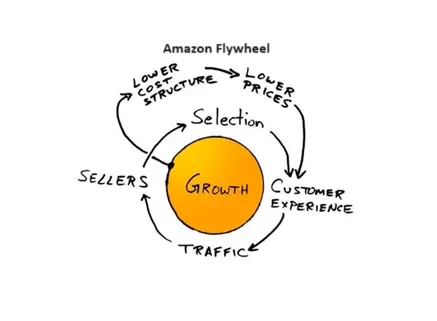
Amazon's core strategy focused on customer obsession. After extensive research, Amazon found that customers cared most about three things when shopping online:
A large selection of products
Low or competitive prices
Seamless delivery and returns.
Rather than focusing on margins and profitability in its early years, Amazon's sole purpose was to deliver on these three features and fundamentally change how consumers felt about online shopping. We include the Amazon flywheel below:
Why books were the perfect wedge
Bezos created a list of roughly 20 products that could benefit from online marketing and narrowed it to compact discs, computer hardware, software, videos, and books. The defining feature: each product had to be homogenised. Consumers had to be sure of what they were purchasing, making price the primary decision driver.
Books won because the category had many titles but only a handful of distributors to negotiate with. More importantly, Amazon's lower cost structure as an online retailer meant it could carry a vastly larger selection without floor space restrictions.
By 1997, Amazon carried more than 2.5 million book titles. A local bookstore had a fraction of that.
The result was astronomical. Customers no longer needed to visit a store. They could choose from an almost unlimited selection with a few clicks at a lower price, and the return policy was easy. Sales soared as more people discovered this new way to shop.
Amazon was trying to change shopping behaviour that was ingrained for years. It had to start small, and books were the perfect product: homogenised, widely demanded, and easy to ship.
Customer reviews emerged from the growing user base, creating a network effect. Hundreds of reviews per product meant shoppers could buy with confidence. Each new customer made the platform more valuable for every other customer.
Track the financial profile alongside the story, and mark the biggest share price rises and drawdowns. Map the key financial metrics against the price: the share price went up X% during these years, while revenue grew Y% and EPS grew Z%. Then go back and read what the market was saying at the time: news articles, sell-side research, shareholder letters.
The key thing to understand is what happened during the biggest value creation moments. Was it secular tailwinds, or good moves by management? Remember these scenarios and test whether the same ones apply to the companies you are looking at.
Amazon is one of the greatest companies in the world, yet if you had bought it right before the dot-com bust, it would have taken you close to a decade to recover your investment. The biggest re-rating came when it started adding higher-margin revenue streams: AWS, then advertising. Ask yourself: are any of the companies you own quietly building out this kind of economic moat?
| Period | Share price | What the business was doing |
|---|---|---|
| 1997-1999 | Up roughly 50x from IPO | The books wedge working; revenue growing over 300% a year; dot-com euphoria doing the rest. |
| 1999-2001 | Down over 90% | The bust. Valuation fell from about $30bn to about $2bn, yet revenue kept growing and the category expansion continued. The thesis was intact; the price was not. |
| 2001-2009 | Broadly sideways | The quiet years. Logistics build-out, Prime launched in 2005, the marketplace opened, AWS launched in 2006. Margins deliberately suppressed by investment while the moat compounded. |
| 2009-2015 | Strong re-rating | The Prime flywheel compounding; AWS growing unseen inside the P&L. |
| 2015 | Step change | First AWS segment disclosure. The market discovers a high-margin infrastructure business hiding inside a retailer, and re-rates the whole company. |
| 2015-2018 | To $1 trillion | AWS and advertising scale; group operating margins inflect upward. |
| 2021-2022 | Down roughly 50% | Post-Covid overbuild in logistics and headcount, then the cost reset and margin recovery. |
The pattern to internalise: the stock fell 90% while the thesis was intact, and went sideways for most of a decade while the moat was being built. The biggest gains came when the market discovered what the business had quietly become.
What Amazon looked like as an investment?
Amazon IPO'd in 1997 at a valuation of roughly $438 million. By 1999, the valuation had reached over $30 billion.
Then the tech wreck hit. Amazon's valuation fell 90%, from $30 billion to roughly $2 billion.
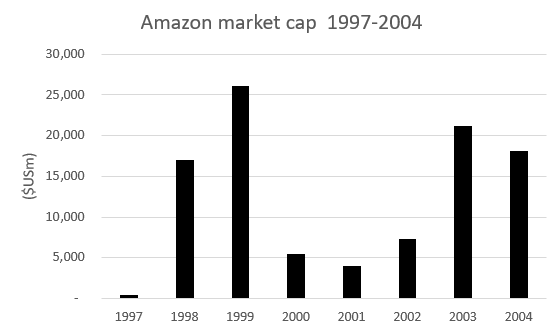
This is a critical lesson: no matter how great a company is, it is not immune to market cycles. For owners of Amazon stock who purchased near the peak, it took until 2007 before the valuation recovered. The timing of your investment matters.
Right before the crash, Amazon sold roughly $700 million in convertible bonds, a move that gave it the capital to survive while many competitors folded. Without that raise, Amazon could look very different today.
Why valuation doesn’t always reflect fundamentals in the short term.
I see similarities between the tech wreck and the recent tech boom and bust. Let me illustrate with an example.
Imagine I opened a cafe with amazing coffee, clearly better than Starbucks. My business has taken off, I've opened 50 cafes with plans to make that 5,000 in three years. I'm valued like a superstar growth company.
Then the environment changes. Interest rates rise. Capital becomes expensive. Funding dries up.
I've committed all my money to opening the fanciest stores and paying top dollar for staff. I no longer have access to capital. I can't hire the best baristas or open cafes in the best locations. Meanwhile, Starbucks has the financial flexibility to keep investing.
Despite seemingly being the same company, my valuation plummets, because due to macroeconomic factors, I can no longer fund the same growth algorithm. I can no longer execute my strategy and now a fundamentally different company despite day to day operations hardly changing. Market sentiment, positioning, environment, and macro conditions do matter.
Some companies in the recent cycle reached valuations on very high multiples based on future growth prospects that subsequently fell apart. In that specific environment, some of those valuations may have been justified, which is one reason bubbles always fool us.
Key takeaway from the early years
Amazon solved a real problem and genuinely improved the consumer experience. It had one primary focus: customer obsession, and built its entire strategy around that ethos.
As the challenger, Amazon allocated resources to where it could provide a differentiated service, using its lower cost structure to offer more selection at lower prices. The flywheel started spinning.
In Part 2, I'll cover how Amazon evolved from an online bookstore into a global ecosystem through Prime, the marketplace strategy that beat eBay, and AWS.
Once they have won the original business, ask how they scaled into a megacap. Was it acquisitions? Consolidation of competitors? New revenue streams that expand the addressable market? Rising margins as the model matures? The scaling playbook is usually where the repeatable lessons live.
How Amazon became everything - Global Dominance [2004-Present]
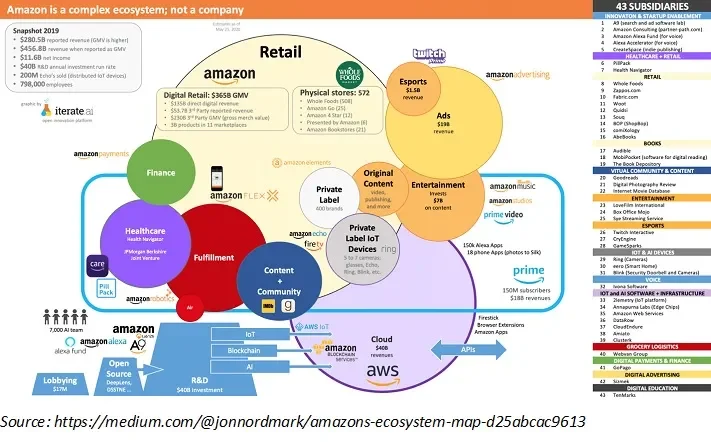
In Part 1, I covered how Amazon used customer obsession and a lower cost structure to disrupt book retail. This part covers the three strategic moves that turned Amazon from an online store into an ecosystem worth $1.3 trillion: Prime, the open marketplace, and AWS.
Amazon Prime - the subscription that changed everything
Amazon knew that fast, seamless delivery was essential for e-commerce to beat traditional retail. But shipping costs were a barrier, especially for everyday household goods.
Amazon Prime was born. Launched in 2005, customers paid $79 upfront for unlimited two-day delivery, compared to $9.48 per shipment. The addressable market expanded immediately as shoppers became willing to buy everyday goods online.
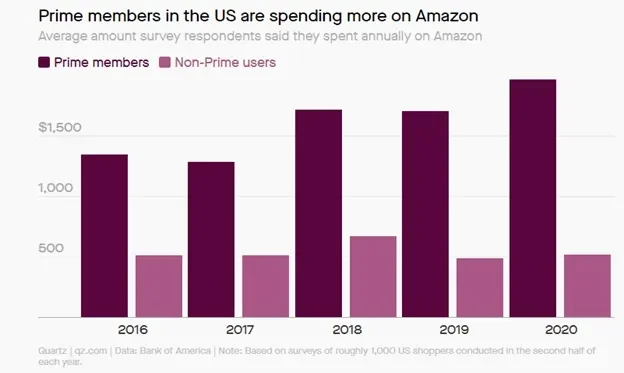
Prime members spend approximately four times more than non-Prime members, driven by both frequency and average basket size.
Prime has since surpassed 230 million subscribers, generating roughly 7% of Amazon's revenue and growing. But the genius of Prime goes beyond shipping.
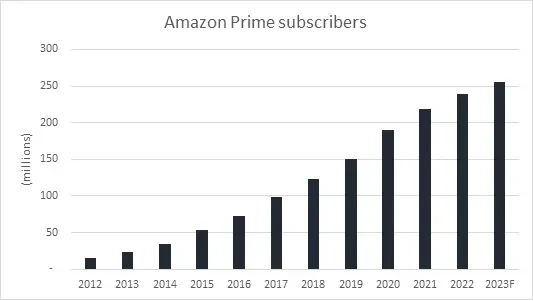
Prime evolved into an entertainment platform, adding Prime Video, Prime Gaming, Prime Music, and Prime Reading. This created a flywheel within a flywheel: revenue from subscribers who signed up for free shipping funds media content, which drives further subscriber growth, which drives more e-commerce purchases.
The open ecosystem and why Amazon beat eBay
Watch how management trades short-term profit for long-term value. Opening the ecosystem to third-party sellers cannibalised Amazon's own retail sales, and years of heavy investment suppressed reported profits while the moat compounded. You will see similar decisions at Microsoft and across the other Mag 7 names.
Look for the culture underneath it: obsessive, customer-fixated, and striving for excellence. That culture is what makes the long-term trade-offs stick, and it starts with how management behaves.
This is, in my view, one of the most important strategic decisions Amazon ever made.
Amazon could have used its competitive advantages to eliminate competitors. Instead, it opened its ecosystem. It expanded from an online store into an online marketplace, allowing other vendors to sell products on the platform and use Amazon's supply chain and delivery services.
Think about what this meant: rather than solely benefiting from its supply chain as a competitive weapon, Amazon let other retailers use that same infrastructure. Competitors became partners. The product catalogue exploded.
It is much harder to displace an ecosystem than a company. Amazon turned competitors into customers.
The strategic difference with eBay is critical. eBay is seller-focused. It treats the seller as its primary customer. The site is built around seller stores, with reviews based on the seller. Amazon is product-focused, search functionality centres on products with multiple sellers at different price points, and reviews focus on the product itself.
While eBay may be preferred by sellers looking to establish their own brand, Amazon proved to be the better platform for customers. Third-party services now contribute roughly 24% of Amazon's total revenue.
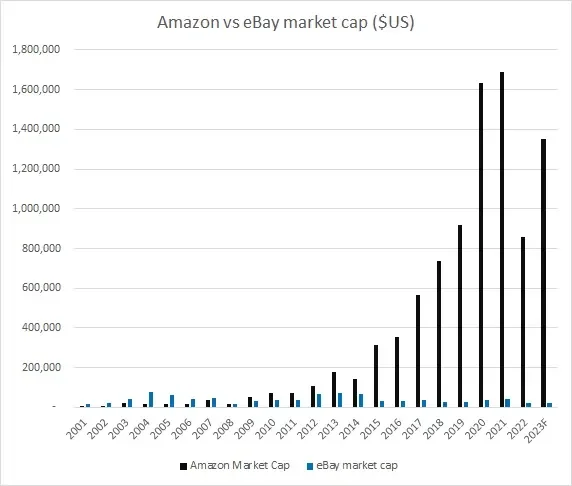
For context: in 2004, eBay was worth nearly $33 billion while Amazon was worth $18 billion. Today, eBay is worth roughly $25 billion (after spinning off PayPal). Amazon is worth $1.3 trillion.
AWS: Sharing the infrastructure
Amazon Web Services follows the same open ecosystem logic. As Amazon scaled, it had to build internal computing infrastructure to handle its hyper-growth. That infrastructure became so good that Amazon began selling it to other businesses.
Businesses could rent compute power, storage, servers, and networking on a pay-as-you-go basis. AWS solved a real problem, companies could outsource their IT infrastructure instead of building and managing it themselves.
AWS now generates roughly 16% of Amazon's revenue at $91 billion, with significantly higher margins than the retail business. It's the profit engine that funds everything else.
The financial profile
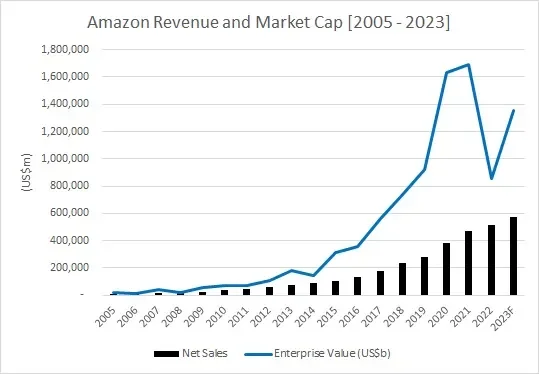
Amazon averaged 27% revenue growth annually from 2005 to 2023. That's almost two decades of 20%+ growth at massive scale, downright ridiculous.
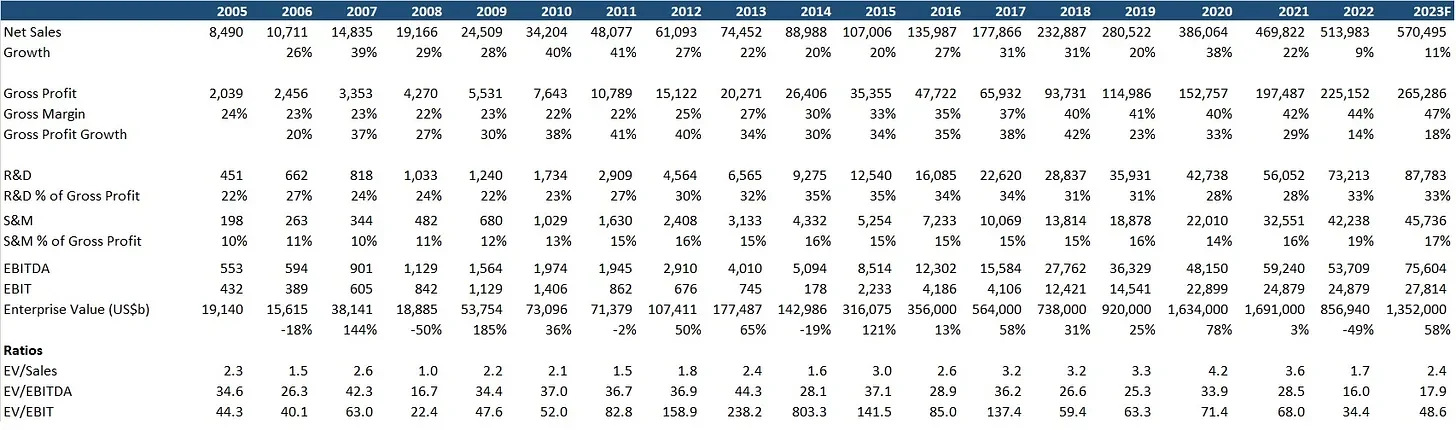
During this period, gross margins improved from 20% to roughly 47% today. Amazon consistently invested 20-30% of gross profit into R&D and 10-20% into sales and marketing. Instead of scaling back spending to take profits, Amazon improved profitability through efficiency and scale.
Investors will reward investment if it is backed up by revenue growth. If Amazon ever chose to completely scale back investment, it would be a significant cash-generating business.
Once Amazon reached critical mass, it used its financial power for acquisitions: Whole Foods ($13.7bn) for grocery, MGM ($8.5bn) for Prime Video content, One Medical ($3.9bn) for healthcare, and Twitch ($970m) for gaming. Each acquisition expanded the ecosystem, entering new markets, unlocking cross-sell synergies, and strengthening the flywheel.
While Amazon's enterprise value skyrocketed, it achieved consistent annual earnings growth, meaning multiples remained somewhat consistent. This just goes to show that as long as you can achieve consistently strong revenue growth, investors will reward investment.
As Amazon grew, it earned investors' trust, essentially unlocking an unlimited supply of capital. Amazon could test other ideas at relatively low risk compared to other companies. Once Amazon reached critical mass, it flexed its financial power to continue growing through acquisitions. I want to highlight Amazon's top five acquisitions:
Whole Foods (US$13.7bn, 2017) - Dramatically expanded Amazon's brick-and-mortar footprint and gave Amazon a much stronger position in grocery deliveries.
Metro-Goldwyn-Mayer (MGM) (US$8.5bn, 2021) - American media company specialising in film and television production to grow Prime Video.
One Medical (US$3.9bn, 2022) - As Amazon looks to grow its healthcare operations
iRobot ($1.4bn, 2022) - Amazon expands its automated robotic devices (Roomba!)
Zappos $1.2bn, 2009) - An online shoe and clothing retailer, acquired to expand Amazon's footprint in clothing goods.
Distil the traits. Write down the characteristics that made the winner win, in plain language. This list is the actual output of the case study: it is what you will pattern-match against when you look at smaller companies earlier in the lifecycle.
What Amazon teaches us about business quality
My key takeaways from studying Amazon:
Amazon solved a real problem and genuinely improved the customer experience. Strategy mattered: one primary focus (customer obsession) executed relentlessly over decades.
Market cycles are important. Despite being a great business, Amazon's valuation fell 90% during the dot-com crash. The timing of your investment matters, and the same company operating in different market conditions can command very different valuations.
Investing in growth works if backed by revenue growth. Amazon never stopped investing in its ecosystem, and investors rewarded it.
The open ecosystem was the decisive strategic move. Turning competitors into partners and building an ecosystem rather than just a company created a moat that is nearly impossible to replicate.
M&A to drive further growth - Once it reached critical mass, Amazon flexed its financial power and began an aggressive M&A strategy to buy out competitors, expand into other sectors and grow its existing business.
Amazon ticks the three boxes I look for in long-term structural growth companies: a large and growing addressable market, a best-in-class product, and a favourable competitive position.
The template
The questions to ask of any winner, in order. Amazon was the worked example; the template applies to any sector.
| Step | Question |
|---|---|
| 01 | History and displacement. How did they start? What was the wedge? What did they do that the incumbents could not, or would not, copy? |
| 02 | Price versus fundamentals. Map the biggest share price rises and drawdowns against what the business was actually doing at the time. |
| 03 | The scaling playbook. Acquisitions, consolidation of competitors, new revenue streams that expand the addressable market, or margin expansion as the model matures? |
| 04 | How did they win? Superior product through R&D, sales and distribution strategy, or both? What was the culture like, and how did management behave? |
| 05 | Distil the traits, then hunt for them in companies earlier in the lifecycle. |